this post covers the 1972 oakland a's and cards numbered 80 to 84 in the set. here are the fronts:
and backs:
what team is this?: the 1972 world champion oakland a's
why this team?: the 1972 a's won 93 games and were the first american league west team to appear in the world series. they were only a few years removed from kansas city, and they won the first of three consecutive world championships by defeating the cincinnati reds.
which players are featured?: that would be bert campaneris, john 'blue moon' odom, sal bando, joe rudi, and ken holtzman.
why these players?: we have 2 of the team's starting pitchers who had very good seasons in 1972, and three of their everyday players (each of them all-stars in 1972), including the 1972 american league mvp runner-up.
bert campaneris was the a's all-star shortstop, although he didn't appear in the 1972 midsummer classic (earl weaver let his own shortstop, bobby grich, play the whole game). campaneris led the american league in stolen bases in 1972 with 52, making it the sixth time in eight years that he had led the league in that category. he also led the league in plate appearances, at bats, and sacrifice hits in 1972, and he played in 149 games. in the postseason, he hit .429 in the alcs (although he only played in two of the five games) and then was just 5 for 28 in the world series. to make things worse, he was caught stealing in his only attempt.
blue moon odom was 15-6 with a 2.50 era during the regular season for the a's in 1972. but you knew that because you read the back of his 'memorable moments' card. a card that is really more about the a's winning the world series than it is about any specific blue moon odom moment. of course, his most memorable moment from 1972 would probably be not either of his two starts in the world series (he was 0-1 despite a 1.59 era in 11.1 innings pitched) but rather his pinch running performance in game 5. odom was called upon to pinch run for gene tenace in the bottom of the 9th inning of game 5 with the a's trailing in the game 5-4 but leading the series 3 games to 1. with one out, odom (who was often called upon to pinch run) was on third base and ill-advisedly tried to score on a short pop up that was caught by joe morgan. he was thrown out to end the game but the a's wound up winning the series in 7 games so it's not really remembered like the merkle boner.
sal bando had been the a's everyday third baseman since 1968 - their first year in oakland. he hit 15 homers with 77 rbi in 1972, and was named to the all-star team for the second time in his career. his average dropped to just .236, however, and he had a lackluster postseason to match. in the world series, he hit .269 with just one extra base hit (a double) and a lone rbi.
joe rudi played 147 games in left field for the a's in 1972, and wound up finishing second in the league mvp voting behind dick allen of the white sox. rudi hit .305 with 19 homers and 75 rbi, and also led the league in hits (181) and triples (9). he was named to the all-star team for the first time in his career and went 1 for 1 with a double off of tug mcgraw. however, rudi's only extra base hit of the world series (in which he hit just .260) was a game 3 solo home run that gave the a's the second run in their 2-1 victory.
ken holtzman makes his second appearance on the blog, having been a member of the memorable and timeless 1969 chicago cubs team. as such, he is the first player in the set to be featured on two different timeless teams. holtzman had been acquired in a trade with the cubs for rick monday after the 1971 season ended. in his first year in oakland, holtzman was 19-11 with a 2.51 era in 39 appearances, 37 of which were starts. he had 16 complete games and 4 shutouts. in the postseason, he made two starts and another relief appearance during the world series. he won game 1, got no decision in game 4, and then was called upon in relief in game 7. he took over from catfish hunter with a 3-1 lead and pete rose on first in the 8th inning and promptly served up a double to joe morgan. that was all for holtzman who was replaced by rollie fingers who eventually preserved the win and the championship for the a's.
the stadium on the back is...?: oakland coliseum - known in 1972 as the oakland alameda county coliseum. currently named (but not known as) the o.co coliseum. the a's have played there since moving to oakland in 1968, although the photo used on the cards is almost certainly not from the 1970's.
did upper deck get it right?: this team certainly belongs in the set, but i am still wondering why the 1972 tigers were chosen instead of the 1972 reds. many of the players on the '72 cincinnati team will show up later in the set, so it would have made some sense. anyway, as far as the a's players are concerned, reggie jackson (who was injured in the alcs and missed the world series), rollie fingers, gene tenace (world series mvp) and possibly vida blue should have been no-brainers, and all but reggie are in the set with other teams. that's weird because reggie, at one time at least, had a contract with upper deck.
for the players that were selected by upper deck, the photos seem to be a mixed bag. campaneris' photo is from 1968 as that is the only year the a's went with the 'oakland' text on the front of their sleeveless jerseys. odom's photo is from 1969 thanks to the all green hat and the capital 'a' on his jersey. in 1970, the team went to yellow bills on the hats, and added the apostrophe-s to the jersey fronts. the other three photos could all be legitimately from 1972 (we know holtzman's is no older than 1972) thanks to the different color combinations and the pullover jersey that the a's introduced that season. if i had to guess, however, i would say that the bando and rudi photos are from 1973, as i don't think they were so scruffy in 1972.
is this team timeless?: no doubt. this was a team that started the dynasty (actually, the 1971 team that lost in the alcs to the orioles was the first a's team to make the postseason since the philadelphia days) and won the first championship for the franchise since the days of connie mack.
Tuesday, May 29, 2012
Monday, May 21, 2012
1972 detroit tigers
this post covers the 1972 detroit tigers and cards numbered 71 to 79 in the set. here are the fronts:
and backs:
so, upper deck skipped 1971, saving us from yet another grouping of that great orioles team but also denying us our first look at the pirates (how cool would it have been to see the likes of dock ellis, al oliver, manny sanguillen, and vic davalillo in this set? the answer is very very cool). alas, we'll have to wait a few years to see pittsburgh in the set. other possibilities from 1971 would have been the a's (we will see plenty of them) and the giants (thankfully they are completely omitted from the set).
what team is this?: 1972 detroit tigers
why this team?: the tigers won the american league east in 1972 with an 86-80 record. they finished a half-game ahead of the boston red sox thanks to the fact that they played one more game as a result of the player strike that delayed the start of the season and wiped out a different number of games for different teams. if you look at the final standings that year, you'll see that not every team played the same number of games. that's pretty fundamental, one would think. the tigers wound up losing the 1972 american league championship series to the a's in 5 games.
which players are featured?: it's a repeat cast from the 1968 detroit tigers team (which makes sense from a set checklist point of view) sans denny mclain who was out of detroit by the time 1972 rolled around. that means we get al kaline, bill freehand, dick mcauliffe, jim northrup, john hiller, mickey lolich, mickey stanley, and willie horton.
why these players?: in addition to from ed brinkman, these were the surviving everyday players from the 1972 tigers team. mickey lolich was the ace, and john hiller a key bullpen cog, although chuck seelbach would have made sense to have been included.
al kaline was 37 during the 1972 season. he played in 106 games and hit .313 in just over 300 plate appearances. he managed to hit 10 homers, the last of which started the scoring in the first game of the crucial season ending three game set against the second place red sox. kaline finished 24th in the league mvp voting and hit .263 with a solo home run in the alcs against the a's. that solo shot came in the top of the 11th inning of game 1 to give the tigers a lead. unfortunately, they were unable to hang on and lost the game in the bottom of the inning.
bill freehan was named to the american league all-star team for the 9th straight year in 1972. in the game, he started at catcher and was 0 for 1 with a walk and a run before being replaced by carlton fisk. during the regular season, freehan hit .262 and slugged 10 homers in 111 games played. behind the plate, he threw out 37% of the would-be base stealers who ran against him, but made an uncharacteristic 8 errors in 105 games as a catcher. freehan hit .250 with a homer and three rbi in the alcs.
dick mcauliffe hit .240 with 8 homers and 30 rbi in 1972. his home run total was the lowest since his rookie season of 1961. the tigers' primary second baseman also hit a solo shot in the alcs.
jim northrup also saw his home run total drop to 8 in 1972. northrup actually had his power numbers drop across the board, slugging just .362 with just 25 extra base hits in 134 games played. he hit .357 in the alcs, but had no extra base hits and just one rbi in the 5 game series.
john hiller triumphantly returned to the big leagues in 1972 after sitting out the 1971 season due to the health concerns. he pitched in just 24 games but had 3 saves and a 2.03 era. all three of his decisions came in his only three starts of the season - two losses and a complete game 5-hitter for the win. hiller pitched in 3 games of the alcs, earning the win in game 4 and posting a perfect 0.00 era in 3.1 innings of work.
mickey lolich went 22-14 for detroit in 1972. his 2.50 era was almost half a run lower than his era from the previous year when he won 25 games. although his strikeout numbers were down, he still k'd 250 batters, good for second in the league behind nolan ryan. as an aside, if mickey lolich didn't retire and miss the 1977 season before returning to the big leagues in 1978, would he have tallied the 168 strikeouts he ultimately needed to reach 3000? and, if so, is mickey lolich in the hall of fame? back to 1972 - lolich made the all-star team that year and pitched 2 innings of scoreless ball in relief of the game's starter, jim palmer. he also finished fourth in the league cy young voting and made 2 starts in the alcs. in game 1, he pitched 10 innings and allowed just one run before he was sent out for the 11th inning with a one run lead. he gave up back to back hits to start the inning and was relieved. the a's scored twice and lolich got the loss. he returned in game 4 and held the a's to a single run in 9 innings of work, but was replaced as the game went to extra innings and didn't get the win when the tigers eventually won in 11.
mickey stanley played center field for the tigers in 142 games during the 1972 season. he hit .234 with 14 homers and 55 rbi. he made only one start in the alcs, but appeared in four of the five games, hitting .333 with 2 singles in 6 at bats.
willie horton appeared in 108 games for detroit in 1972 as the tigers continued to work three players (horton, kaline, and northrup) across two positions (right and left field). like the rest, horton's numbers dipped (11/36/.231) although i don't know if that was due to playing time or the strike or just some fine 1972 pitching. in the alcs, horton was held to just one hit in 10 official at bats.
the stadium on the back is...?: "the corner", also known as "old" tiger stadium. it opened in 1912 (as navin stadium) and was the home to the tigers through the 1999 season.
did upper deck get it right?: well, they tried i suppose. i think that this is the first instance of a team being featured simply because of the checklist. all of these players were part of the 1968 tiger team (definitely timeless) and so were already in the set. so, it was easy for upper deck to have them sign some more cards.
as for the players, i think these are the right guys to be featured although hiller wasn't with the team the full season, and joe coleman and chuck seelbach would have been worthy additions to the set.
the photos are a mixed bag. kaline is too young in his photo for it to have been from 1972, and freehan is sporting the anniversary patch that was worn in 1969, as is horton. john hiller is also sporting the away grays that were last worn in 1971. as for the rest, they are wearing the away jersey that was first donned by tiger players in 1972, so they could be legit, although i would guess that the northrup and stanley images are from later in the 70's. not helping is the guy lurking in the background of northrup's photo. that's long time tiger coach (and former dodger) dick tracewski. he coached for the tigers from 1972-1995, so we can't narrow the timing of the photo down that way.
is this team timeless?: although 1972 was the final postseason appearance for each of these players, i don't see much of a reason to include them in the set. not timeless.
and backs:
so, upper deck skipped 1971, saving us from yet another grouping of that great orioles team but also denying us our first look at the pirates (how cool would it have been to see the likes of dock ellis, al oliver, manny sanguillen, and vic davalillo in this set? the answer is very very cool). alas, we'll have to wait a few years to see pittsburgh in the set. other possibilities from 1971 would have been the a's (we will see plenty of them) and the giants (thankfully they are completely omitted from the set).
what team is this?: 1972 detroit tigers
why this team?: the tigers won the american league east in 1972 with an 86-80 record. they finished a half-game ahead of the boston red sox thanks to the fact that they played one more game as a result of the player strike that delayed the start of the season and wiped out a different number of games for different teams. if you look at the final standings that year, you'll see that not every team played the same number of games. that's pretty fundamental, one would think. the tigers wound up losing the 1972 american league championship series to the a's in 5 games.
which players are featured?: it's a repeat cast from the 1968 detroit tigers team (which makes sense from a set checklist point of view) sans denny mclain who was out of detroit by the time 1972 rolled around. that means we get al kaline, bill freehand, dick mcauliffe, jim northrup, john hiller, mickey lolich, mickey stanley, and willie horton.
why these players?: in addition to from ed brinkman, these were the surviving everyday players from the 1972 tigers team. mickey lolich was the ace, and john hiller a key bullpen cog, although chuck seelbach would have made sense to have been included.
al kaline was 37 during the 1972 season. he played in 106 games and hit .313 in just over 300 plate appearances. he managed to hit 10 homers, the last of which started the scoring in the first game of the crucial season ending three game set against the second place red sox. kaline finished 24th in the league mvp voting and hit .263 with a solo home run in the alcs against the a's. that solo shot came in the top of the 11th inning of game 1 to give the tigers a lead. unfortunately, they were unable to hang on and lost the game in the bottom of the inning.
bill freehan was named to the american league all-star team for the 9th straight year in 1972. in the game, he started at catcher and was 0 for 1 with a walk and a run before being replaced by carlton fisk. during the regular season, freehan hit .262 and slugged 10 homers in 111 games played. behind the plate, he threw out 37% of the would-be base stealers who ran against him, but made an uncharacteristic 8 errors in 105 games as a catcher. freehan hit .250 with a homer and three rbi in the alcs.
dick mcauliffe hit .240 with 8 homers and 30 rbi in 1972. his home run total was the lowest since his rookie season of 1961. the tigers' primary second baseman also hit a solo shot in the alcs.
jim northrup also saw his home run total drop to 8 in 1972. northrup actually had his power numbers drop across the board, slugging just .362 with just 25 extra base hits in 134 games played. he hit .357 in the alcs, but had no extra base hits and just one rbi in the 5 game series.
john hiller triumphantly returned to the big leagues in 1972 after sitting out the 1971 season due to the health concerns. he pitched in just 24 games but had 3 saves and a 2.03 era. all three of his decisions came in his only three starts of the season - two losses and a complete game 5-hitter for the win. hiller pitched in 3 games of the alcs, earning the win in game 4 and posting a perfect 0.00 era in 3.1 innings of work.
mickey lolich went 22-14 for detroit in 1972. his 2.50 era was almost half a run lower than his era from the previous year when he won 25 games. although his strikeout numbers were down, he still k'd 250 batters, good for second in the league behind nolan ryan. as an aside, if mickey lolich didn't retire and miss the 1977 season before returning to the big leagues in 1978, would he have tallied the 168 strikeouts he ultimately needed to reach 3000? and, if so, is mickey lolich in the hall of fame? back to 1972 - lolich made the all-star team that year and pitched 2 innings of scoreless ball in relief of the game's starter, jim palmer. he also finished fourth in the league cy young voting and made 2 starts in the alcs. in game 1, he pitched 10 innings and allowed just one run before he was sent out for the 11th inning with a one run lead. he gave up back to back hits to start the inning and was relieved. the a's scored twice and lolich got the loss. he returned in game 4 and held the a's to a single run in 9 innings of work, but was replaced as the game went to extra innings and didn't get the win when the tigers eventually won in 11.
mickey stanley played center field for the tigers in 142 games during the 1972 season. he hit .234 with 14 homers and 55 rbi. he made only one start in the alcs, but appeared in four of the five games, hitting .333 with 2 singles in 6 at bats.
willie horton appeared in 108 games for detroit in 1972 as the tigers continued to work three players (horton, kaline, and northrup) across two positions (right and left field). like the rest, horton's numbers dipped (11/36/.231) although i don't know if that was due to playing time or the strike or just some fine 1972 pitching. in the alcs, horton was held to just one hit in 10 official at bats.
the stadium on the back is...?: "the corner", also known as "old" tiger stadium. it opened in 1912 (as navin stadium) and was the home to the tigers through the 1999 season.
as for the players, i think these are the right guys to be featured although hiller wasn't with the team the full season, and joe coleman and chuck seelbach would have been worthy additions to the set.
the photos are a mixed bag. kaline is too young in his photo for it to have been from 1972, and freehan is sporting the anniversary patch that was worn in 1969, as is horton. john hiller is also sporting the away grays that were last worn in 1971. as for the rest, they are wearing the away jersey that was first donned by tiger players in 1972, so they could be legit, although i would guess that the northrup and stanley images are from later in the 70's. not helping is the guy lurking in the background of northrup's photo. that's long time tiger coach (and former dodger) dick tracewski. he coached for the tigers from 1972-1995, so we can't narrow the timing of the photo down that way.
is this team timeless?: although 1972 was the final postseason appearance for each of these players, i don't see much of a reason to include them in the set. not timeless.
Labels:
1972,
al kaline,
bill freehan,
black and white,
color,
detroit tigers,
dick mcauliffe,
division champions,
jim northrup,
john hiller,
mickey lolich,
mickey stanley,
tiger stadium,
willie horton
Monday, May 7, 2012
1970 baltimore orioles
this post covers the 1970 baltimore orioles and cards numbered 61 to 71 in the set. here are the fronts:
and backs:
what team is this?: the 1970 world champion baltimore orioles
why this team?: they won the world series for the second time in their history, winning 108 games in the regular season and going 7-1 in the postseason. they also boasted the league's mvp and three of the top five cy young award vote getters.
which players are featured?: all the same guys from 1969, as would be expected. boog powell, brooks robinson, davey johnson, merv rettenmund, eddie watt, frank robinson, jim palmer, mike culler, paul blair, pete richert, and ellie hendricks.
why these players?: these were the guys that made the o's tick in the late 60's and early 70's.
the stadium on the back is...?: still memorial stadium, as it should be.
did upper deck get it right?: we know that the bird logo is not right, and that the players are appropriate to represent the team. it would have been nice, perhaps, to have earl weaver included, and i would have understood if bobby grich were here as he shows up with the angels later in the set. still, i am glad he is not, as he was not a big part of the orioles' 1970 team.
so, that brings us to the photos. after using a later-era photo for boog on the 1969 card, upper deck reverted to an older photo for him here, similar to the one they used on the 1966 installment. the uniforms look legitimate for powell, brooks, rettenmund, watt, frobby, blair, and richert. davey johnson, however, is wearing a uniform that was introduced in 1971, as is mike cuellar. jim palmer, on the other hand, is sporting the white front panel cap which wasn't introduced until 1975. his photo looks like it is from the latter part of palmer's career - possibly from the early 80's. and then there is ellie hendricks. he is shown sporting the sleeveless jersey that was last worn by the orioles in 1969. close, but no cigar.
is this team timeless?: yes. the orioles in 1970 finished 15 games ahead of the yankees in the al east and dispatched the reds in the world series 4 games to 1. they were the world champions at the time i was born, and that's good enough for me.
and backs:
what team is this?: the 1970 world champion baltimore orioles
why this team?: they won the world series for the second time in their history, winning 108 games in the regular season and going 7-1 in the postseason. they also boasted the league's mvp and three of the top five cy young award vote getters.
which players are featured?: all the same guys from 1969, as would be expected. boog powell, brooks robinson, davey johnson, merv rettenmund, eddie watt, frank robinson, jim palmer, mike culler, paul blair, pete richert, and ellie hendricks.
why these players?: these were the guys that made the o's tick in the late 60's and early 70's.
boog powell started at first base but went 0 for 3 in the all-star game in 1970. that's ok, because after finishing 2nd in the league mvp voting in 1969, boog took home the hardware in 1970 with 35 homers and 114 rbi. he hit 2 more homers and drove in 5 runs in the world series.
brooks robinson was the mvp of the world series in 1970 with 2 homers, 6 rbi and made some nice plays on defense, as his memorable moments card will attest. otherwise, it was a typical year for the hall of famer, as he won another gold glove and was named to the all-star team. speaking of which, robinson went 2 for 3 with 2 rbi in the all-star game as a reserve behind harmon killebrew at third base.
davey johnson won his second straight gold glove and started the all-star game at second base, going 1 for 5 in the game. he hit .313 in the world series after hitting .364 with two homers in the alcs against the twins.
merv rettenmund hit .322 with a career high 18 homers as the orioles 4th outfielder in 1970. he appeared in 106 games and played each outfield position in at least 30 games. rettenmund made two starts in the postseason (plus one appearance as a pinch-hitter) and he made them count. he was 1 for 3 with 2 walks and an rbi in game 2 of the alcs and then went 2 for 4 with a walk, 2 runs scored, and a homer and 2 rbi in game 5 of the world series.
eddie watt was 7-7 with 12 saves for the orioles during the 1970 world series. he made only one postseason appearance in 1970, and was saddled with the o's only loss for his troubles.
frank robinson went 0 for 3 as the starting right fielder in the all-star game, and posted a line of 25/78/.306 as the orioles' right fielder during the regular season. it's worth noting that frobby hit two grand slams in a single game during the regular season. he hit three more home runs in the postseason, including two in the world series.
jim palmer won 20 games for the first time in his hall of fame career in 1970. he led the league in shutouts and innings pitched, and was named to the all-star team for the first time. in fact, he was named the starter for the american league, and he pitched three scoreless innings in the game. he also recorded three strikeouts - willie mays to start the bottom of the first, and then tony perez and johnny bench in the second inning. palmer finished 5th in the cy young voting and went 2-0 in three postseason starts, including a win in game 1 of the fall classic against the reds.
mike cuellar led the league with 24 wins, 40 games started, and 21 complete games in 1970. he made the all-star team and finished 4th in his attempt to defend his reign as the cy young award winner. cuellar was knocked around in his lone alcs start, but he came back to pitch well in two world series starts, including a complete game victory in the game 5 clincher.
paul blair won a gold glove for the second straight year as the orioles' center fielder. blair was held to just one hit during the alcs, but he came out strong in the world series and posted a .474 average with 3 rbi and 5 runs scored.
pete richert was 7-2 with 13 saves and a 1.98 era out of the bullpen for the 1970 orioles. he pitched to just one batter in the postseason, but that batter was bobby tolan, and richert got him to line out to end game 1 of the world series with the tying run on base giving richert his lone career postseason save.
ellie hendricks matched his career high with 12 homers in 1970. he appeared in 106 games as the orioles' primary backstop and helped guide the pitching staff to 60 complete games and three 20-game winners. he hit .364 with a home run and 4 rbi in the world series.
the stadium on the back is...?: still memorial stadium, as it should be.
did upper deck get it right?: we know that the bird logo is not right, and that the players are appropriate to represent the team. it would have been nice, perhaps, to have earl weaver included, and i would have understood if bobby grich were here as he shows up with the angels later in the set. still, i am glad he is not, as he was not a big part of the orioles' 1970 team.
so, that brings us to the photos. after using a later-era photo for boog on the 1969 card, upper deck reverted to an older photo for him here, similar to the one they used on the 1966 installment. the uniforms look legitimate for powell, brooks, rettenmund, watt, frobby, blair, and richert. davey johnson, however, is wearing a uniform that was introduced in 1971, as is mike cuellar. jim palmer, on the other hand, is sporting the white front panel cap which wasn't introduced until 1975. his photo looks like it is from the latter part of palmer's career - possibly from the early 80's. and then there is ellie hendricks. he is shown sporting the sleeveless jersey that was last worn by the orioles in 1969. close, but no cigar.
is this team timeless?: yes. the orioles in 1970 finished 15 games ahead of the yankees in the al east and dispatched the reds in the world series 4 games to 1. they were the world champions at the time i was born, and that's good enough for me.
Labels:
1970,
baltimore orioles,
black and white,
boog powell,
brooks robinson,
color,
davey johnson,
eddie watt,
ellie hendricks,
frank robinson,
jim palmer,
memorable moments,
memorial stadium,
merv rettenmund,
mike cuellar,
paul blair,
pete richert,
world champions
Thursday, March 29, 2012
1969 new york mets
this post covers the 1969 new york mets and cards number 57 to 60 in the set. here are the fronts:
and backs:
what team is this?: 1969 new york mets
why this team?: the amazin' mets, led by gil hodges, won the world series in their 8th year of existence, defeating the heavily favored baltimore orioles.
which players are featured?: ed kranepool, jerry koosman (who gets a 'memorable moments' card thanks to the fact that he pitched the game 5 clincher in the fall classic), nolan ryan, tom seaver
why these players?: ed kranepool is mr. met (not the one with the big baseball head), jerry koosman and tom seaver were the aces of the staff, and nolan ryan won his only world series title during his short time in new york. let's take a closer look.
ed kranepool was just 17 when he debuted for the mets in 1962. he held down the first base spot for at least part of 18 seasons for the mets, and spent 112 games there in their championship season of 1969. he hit only 11 homers and his average was just .238, but he could play the field well. when the postseason rolled around, kranepool hit .250 in the 3 games against the braves and managed just one game played in the world series. he went 1 for 4, but his lone hit was a home run.
jerry koosman, in just his second full season, won 17 games for the mets in 32 starts. he struck out 15 padres in a 10-innings stint in may, and then struck out 13 cubbies in a big 3-2 win against their nl east rivals. koosman also made the all-star team and pitched 1.2 scoreless innings in the contest, including a bit of foreshadowing that came when he struck out the orioles' brooks robinson. in the postseason, koosman struggled in his only start of the nlcs against the braves, but then won games 2 and 5 of the world series, coming just one out shy of hurling two complete games.
nolan ryan split his 1969 season between the bullpen (15 appearances, 1 save) and the rotation (10 starts, 2 complete games). he spent the postseason in the bullpen, but was only called upon twice. in game 3 of the playoffs, he threw 7 innings in relief to get the win and then in game 3 of the world series, he closed out the mets' 5-0 victory with 2.1 innings to earn the save. this outing was memorialized in the 1970 topps set with the 'ryan saves the day' card.
tom seaver won the first of his 3 cy young awards in 1969 (he finished second in the mvp voting, too) as he was 25-7 with a 2.21 era. he also threw 18 complete games (8 of which came in his final 8 starts of the season) and 5 shutouts (3 of which came in the 8-start stretch). on july 9, tom terrific was perfect for 8.1 innings against the cubs before allowing a single to jim qualls. he retired the next two batters for a one-hit shutout, but i don't believe he ever came as close to perfection again. seaver was not dominating in his lone nlcs start, although he earned the win in game 1. he took the loss in his next start - game 1 of the world series - but then bounced back with a 10-inning complete game victory in game 4 to give the mets a 3-1 series lead.
the stadium on the back is...?: shea stadium which is where the mets were playing in 1969. however, the photo is not from 1969 as evidenced by the diet coke sign.
did upper deck get it right?: i have no problems with the players chosen, although it would have been nice to see jerry grote, and maybe cleon jones or ron swoboda would have made sense, too. the photos, however, are all over the place. kranepool's photo obviously comes from much later in his mets tenure - 1978 or 1979 based on the collar. koosman and ryan seem appropriate, especially given that nolan ryan was only around through 1971. seaver, however, is shown during his second go-around with the mets which was in 1983. and, as i mentioned earlier, the stadium is correct, but it's not an era-appropriate photo on the backs of the cards.
is this team timeless?: no doubt about it. they were 'amazin!'
and backs:
what team is this?: 1969 new york mets
why this team?: the amazin' mets, led by gil hodges, won the world series in their 8th year of existence, defeating the heavily favored baltimore orioles.
which players are featured?: ed kranepool, jerry koosman (who gets a 'memorable moments' card thanks to the fact that he pitched the game 5 clincher in the fall classic), nolan ryan, tom seaver
why these players?: ed kranepool is mr. met (not the one with the big baseball head), jerry koosman and tom seaver were the aces of the staff, and nolan ryan won his only world series title during his short time in new york. let's take a closer look.
ed kranepool was just 17 when he debuted for the mets in 1962. he held down the first base spot for at least part of 18 seasons for the mets, and spent 112 games there in their championship season of 1969. he hit only 11 homers and his average was just .238, but he could play the field well. when the postseason rolled around, kranepool hit .250 in the 3 games against the braves and managed just one game played in the world series. he went 1 for 4, but his lone hit was a home run.
jerry koosman, in just his second full season, won 17 games for the mets in 32 starts. he struck out 15 padres in a 10-innings stint in may, and then struck out 13 cubbies in a big 3-2 win against their nl east rivals. koosman also made the all-star team and pitched 1.2 scoreless innings in the contest, including a bit of foreshadowing that came when he struck out the orioles' brooks robinson. in the postseason, koosman struggled in his only start of the nlcs against the braves, but then won games 2 and 5 of the world series, coming just one out shy of hurling two complete games.
nolan ryan split his 1969 season between the bullpen (15 appearances, 1 save) and the rotation (10 starts, 2 complete games). he spent the postseason in the bullpen, but was only called upon twice. in game 3 of the playoffs, he threw 7 innings in relief to get the win and then in game 3 of the world series, he closed out the mets' 5-0 victory with 2.1 innings to earn the save. this outing was memorialized in the 1970 topps set with the 'ryan saves the day' card.
tom seaver won the first of his 3 cy young awards in 1969 (he finished second in the mvp voting, too) as he was 25-7 with a 2.21 era. he also threw 18 complete games (8 of which came in his final 8 starts of the season) and 5 shutouts (3 of which came in the 8-start stretch). on july 9, tom terrific was perfect for 8.1 innings against the cubs before allowing a single to jim qualls. he retired the next two batters for a one-hit shutout, but i don't believe he ever came as close to perfection again. seaver was not dominating in his lone nlcs start, although he earned the win in game 1. he took the loss in his next start - game 1 of the world series - but then bounced back with a 10-inning complete game victory in game 4 to give the mets a 3-1 series lead.
the stadium on the back is...?: shea stadium which is where the mets were playing in 1969. however, the photo is not from 1969 as evidenced by the diet coke sign.
did upper deck get it right?: i have no problems with the players chosen, although it would have been nice to see jerry grote, and maybe cleon jones or ron swoboda would have made sense, too. the photos, however, are all over the place. kranepool's photo obviously comes from much later in his mets tenure - 1978 or 1979 based on the collar. koosman and ryan seem appropriate, especially given that nolan ryan was only around through 1971. seaver, however, is shown during his second go-around with the mets which was in 1983. and, as i mentioned earlier, the stadium is correct, but it's not an era-appropriate photo on the backs of the cards.
is this team timeless?: no doubt about it. they were 'amazin!'
Monday, March 12, 2012
1969 chicago cubs
this post covers the 1969 chicago cubs and cards number 50 to 56 in the set. here are the fronts:
and backs:
for the first time, the set includes a team that didn't qualify for the postseason. this presents a problem for me as i have been labeling these posts with the level to which each team has risen, such as 'american league champions' or 'world series champions'. what do i call the 1969 cubbies? i should note that wrigley wax has already covered a lot of the info i expound upon, and here's his dissertation. i'll borrow from it a bit as well.
what team is this?: the 1969 chicago cubs
why this team?: the cubs famously 'collapsed' and allowed the mets to win the national league east in the first year of divisional play. this is the only cubs team included in the set, and i would argue that the 1984 team may have been a better choice. but what do i know...
which players are featured?: billy williams, randy hundley, ernie banks, fergie jenkins, jim hickman, ken holtzman, and ron santo who gets a memorable moment card for clicking his heels. weird.
why these players?: this is a pretty good representation of the 1969 cubs - four of the eight regulars plus two of the three top starters with a total of four hall-of-famers. let's take a closer look.
billy williams had a pretty good season in 1969 as the cubs' left fielder. the first hof'er to be featured led the league (again) in games played with 163. the extra game was due to a game the cubs played against the reds which was deemed a tie for some reason. not sure how that works - maybe someone out there can shed some light? williams posted a line of 21/95/.293 with 103 runs scored. one of those homers was the second to last home run that don drysdale gave up in his career.
randy hundley caught in 151 of the cubs' 163 games in 1969, including 136 complete games. he had his last solid full season that year, hitting .255 with 18 homers and 64 rbi. he also made the all-star team for the only time in his career. perhaps the highlight of his season, however, was the birth of his son and future dodger double dipper todd in may.
ernie banks enjoyed what was really his last hurrah in 1969. hof'er number two played 155 games at first, and hit 23 homers while driving in 106. mr. cub finished 12th in the league mvp vote and made the all-star team for the last time in his career. in the game, both he and willie mays pinch hit in the fifth inning and made outs.
fergie jenkins won 20 games or more for the third year in a row, posting 21 victories while leading the league in starts (42) and strikeouts (273). still, he got no love from the mvp or cy young voters, nor was he named to the all-star squad. the third hall-of-famer on this team would go on to win 20 or greater in each of the next three seasons.
jim hickman was the cubs' right fielder in 1969, and he put up some fairly pedestrian numbers that year. he did manage to hit 21 homers, but he only drove in 54 and hit just .237. he did much better in 1970, when he slugged 32 long balls and drove in 115 for the cubs while batting .315. hickman, of course, was an original met and played for them from 1962 through 1966, and i can't imagine how he felt to be passed in the standing by his old team.
ken holtzman was the third starter on the 1969 cubs behind jenkins and bill hand who won 20 games. holtzman wound up with 17 wins in 39 starts. holtzman threw three straight shutouts in may, and then threw a no-hitter against the braves in august. strangely, he walked three in that game and struck out none. it was his only game of the season in which he failed to strike anyone out.
ron santo is the fourth hall-of-famer featured in this team set. not sure if he was clicking his heels like charlie chaplin or judy garland, but his 1969 season was pretty solid - 29 homers and a career high 123 rbi along with a .289 batting average. he walked 96 times just as he had the previous two seasons, however in 1969 that wasn't quite enough to lead the league as he had in 1967 and 1968. santo made the all-star team and ultimately placed 5th in the league mvp voting.
the stadium on the back is...?: wrigley field. the cubs have played there since 1916, so that's good. however, i don't think the rooftop seats showed up until the 1990's.
did upper deck get it right?: well, this team was the one that got all the cubbie faithful excited about a possible return to the world series for the first time since 1945. it is iconic, if not timeless. the players all make sense, so no complaints there, althoughi suppose bill hands and phil regan (their closer) would have been good players to feature as well. it's the photos where they really missed the mark.
as wrigley wax demonstrates, the banks photo is from the 1950's, the williams is from the 1970's, and the jenkins is from the 1980's. the santo and the hickman are potentially from 1969, and the hundley and holtzman photos are indeed from 1969, thanks to the centennial patches each player is wearing.
is this team timeless?: perhaps. up by 9 games in early august and 5 on september 3rd, the cubs lost 8 in a row and 11 of their last 13 games while the mets were surging. cubs fans had their hopes dashed, so this team resonates with a lot of people. it's the only cubs team in the set, and only a couple of the players (ken holtzman and billy williams) appear on other cards in the set. i still don't get is why they didn't feature the 1984 team in the set. to me, that team was just as timeless as this one, and they actually made the postseason. plus, we could have had some additional bill buckner, ron cey and davey lopes cards. what do you think?
and backs:
for the first time, the set includes a team that didn't qualify for the postseason. this presents a problem for me as i have been labeling these posts with the level to which each team has risen, such as 'american league champions' or 'world series champions'. what do i call the 1969 cubbies? i should note that wrigley wax has already covered a lot of the info i expound upon, and here's his dissertation. i'll borrow from it a bit as well.
what team is this?: the 1969 chicago cubs
why this team?: the cubs famously 'collapsed' and allowed the mets to win the national league east in the first year of divisional play. this is the only cubs team included in the set, and i would argue that the 1984 team may have been a better choice. but what do i know...
which players are featured?: billy williams, randy hundley, ernie banks, fergie jenkins, jim hickman, ken holtzman, and ron santo who gets a memorable moment card for clicking his heels. weird.
why these players?: this is a pretty good representation of the 1969 cubs - four of the eight regulars plus two of the three top starters with a total of four hall-of-famers. let's take a closer look.
billy williams had a pretty good season in 1969 as the cubs' left fielder. the first hof'er to be featured led the league (again) in games played with 163. the extra game was due to a game the cubs played against the reds which was deemed a tie for some reason. not sure how that works - maybe someone out there can shed some light? williams posted a line of 21/95/.293 with 103 runs scored. one of those homers was the second to last home run that don drysdale gave up in his career.
randy hundley caught in 151 of the cubs' 163 games in 1969, including 136 complete games. he had his last solid full season that year, hitting .255 with 18 homers and 64 rbi. he also made the all-star team for the only time in his career. perhaps the highlight of his season, however, was the birth of his son and future dodger double dipper todd in may.
ernie banks enjoyed what was really his last hurrah in 1969. hof'er number two played 155 games at first, and hit 23 homers while driving in 106. mr. cub finished 12th in the league mvp vote and made the all-star team for the last time in his career. in the game, both he and willie mays pinch hit in the fifth inning and made outs.
fergie jenkins won 20 games or more for the third year in a row, posting 21 victories while leading the league in starts (42) and strikeouts (273). still, he got no love from the mvp or cy young voters, nor was he named to the all-star squad. the third hall-of-famer on this team would go on to win 20 or greater in each of the next three seasons.
jim hickman was the cubs' right fielder in 1969, and he put up some fairly pedestrian numbers that year. he did manage to hit 21 homers, but he only drove in 54 and hit just .237. he did much better in 1970, when he slugged 32 long balls and drove in 115 for the cubs while batting .315. hickman, of course, was an original met and played for them from 1962 through 1966, and i can't imagine how he felt to be passed in the standing by his old team.
ken holtzman was the third starter on the 1969 cubs behind jenkins and bill hand who won 20 games. holtzman wound up with 17 wins in 39 starts. holtzman threw three straight shutouts in may, and then threw a no-hitter against the braves in august. strangely, he walked three in that game and struck out none. it was his only game of the season in which he failed to strike anyone out.
ron santo is the fourth hall-of-famer featured in this team set. not sure if he was clicking his heels like charlie chaplin or judy garland, but his 1969 season was pretty solid - 29 homers and a career high 123 rbi along with a .289 batting average. he walked 96 times just as he had the previous two seasons, however in 1969 that wasn't quite enough to lead the league as he had in 1967 and 1968. santo made the all-star team and ultimately placed 5th in the league mvp voting.
the stadium on the back is...?: wrigley field. the cubs have played there since 1916, so that's good. however, i don't think the rooftop seats showed up until the 1990's.
did upper deck get it right?: well, this team was the one that got all the cubbie faithful excited about a possible return to the world series for the first time since 1945. it is iconic, if not timeless. the players all make sense, so no complaints there, althoughi suppose bill hands and phil regan (their closer) would have been good players to feature as well. it's the photos where they really missed the mark.
as wrigley wax demonstrates, the banks photo is from the 1950's, the williams is from the 1970's, and the jenkins is from the 1980's. the santo and the hickman are potentially from 1969, and the hundley and holtzman photos are indeed from 1969, thanks to the centennial patches each player is wearing.
is this team timeless?: perhaps. up by 9 games in early august and 5 on september 3rd, the cubs lost 8 in a row and 11 of their last 13 games while the mets were surging. cubs fans had their hopes dashed, so this team resonates with a lot of people. it's the only cubs team in the set, and only a couple of the players (ken holtzman and billy williams) appear on other cards in the set. i still don't get is why they didn't feature the 1984 team in the set. to me, that team was just as timeless as this one, and they actually made the postseason. plus, we could have had some additional bill buckner, ron cey and davey lopes cards. what do you think?
Friday, February 24, 2012
1969 baltimore orioles
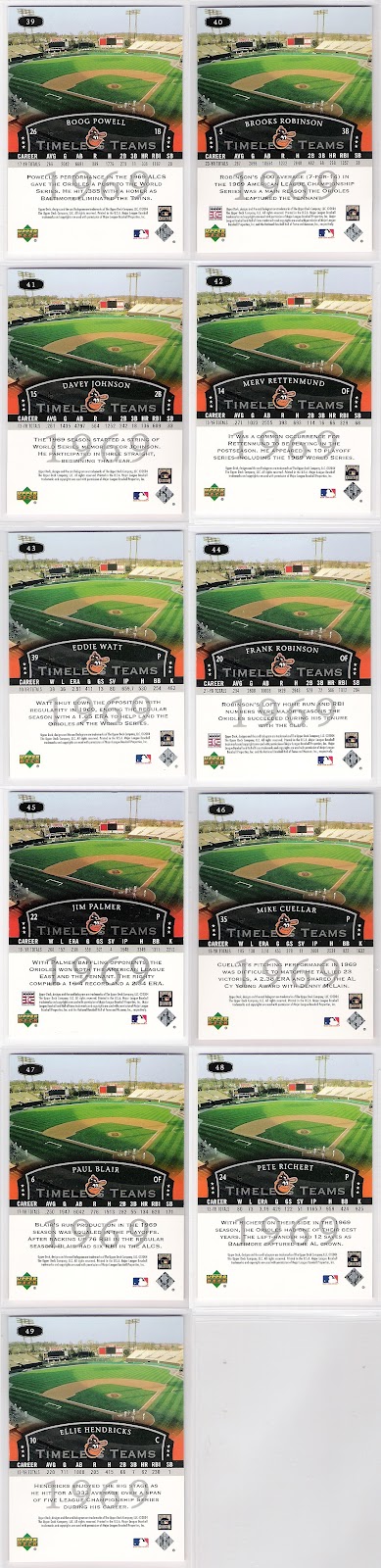
this post covers the 1969 baltimore orioles and cards number 39 to 49 in the set. here are the fronts:
and backs:
for the third time, we have a team without a 'memorable moment'. we also have 11 players featured - by far the most we've seen so far. all the players that were featured in the previous orioles post (1966) are still with the team and included in the set.
what team is this: 1969 baltimore orioles
why this team?: the '69 orioles won 109 games in the first year of divisional play. they beat the minnesota twins in the american league championship series 3 games to none, but then ran into the amazing mets in the world series.
which players are featured?: boog powell, brooks robinson, davey johnson, merv rettenmund, eddie watt, frank robinson, jim palmer, mike cuellar, paul blair, pete richert, and ellie hendricks
why these players?: these guys were, for the most part, the core of the orioles' dynasty of the late 1960's.
boog powell was named to the all-star team for the second time, and finished 2nd in the league mvp voting (behind harmon killebrew) in 1969 thanks to his 37/121/.304 line. he hit .385 with a solo home run in the alcs and then had 5 hits (none for extra bases) in the world series, batting .263 against the mets.
brooks robinson hit only .234 in the regular season, but still won another gold glove. he hit 23 homers and drove in 84 runs along the way, and then hit .500 (7 for 14) in the alcs. in the world series, he was limited to a single in 19 at bats for a lowly .053 average.
davey johnson was the orioles' second baseman and hit .280 in the regular season. he was named to the all-star team for the second season in a row, and won his first gold glove. johnson actually had a better postseason in 1966 (his rookie year) than he did in 1969. maybe upper deck should have included him with that team instead of this one. in the alcs he hit only .231 and then managed just one hit in the world series for an average of .083.
merv rettenmund's inclusion in this set with this team is kind of a headscratcher. he wasn't a regular, appearing in 95 games and hitting .247 during the regular season. in the postseason, he made a single appearance in each the alcs and the world series, without an at bat in either.
eddie watt shared the 'closer' duties with pete richert. he saved 16 games and had a 1.65 era in 56 appearances. in the alcs, watt pitched 2 perfect innings. after a scoreless two-inning outing in game 4 of the world series, watt wound up taking the loss in game 5 despite giving up just a single unearned run.
frank robinson was right behind boog powell in the 1969 al mvp vote, hitting .308 while slugging 32 homers and driving in 100 runs for the final time in his career. he hit .333 with a home run in the alcs and added a solo shot in the world series, although his average over those 5 games against the mets was just .188.
jim palmer did not pitch in the majors in 1968 (he appeared in only 10 minor league games that year) but returned to the orioles' rotation for the 1969 season. he wound up with a record of 16-4 in 23 starts. he threw 11 complete games and 6 shutouts and also made 3 relief appearances. he was 1-0 against the twins in the alcs, throwing another complete game, and then lost game 3 of the world series by allowing 4 runs in 6 innings of work.
mike cuellar was the al cy young award winner in 1969, although he didn't lead the league in any major pitching category. he won 23 games (2nd in the league) and had a 2.38 era (third). cuellar had a no-decision in his lone alcs start, and then earned the win in game 1 of the world series. he returned to the mound a few days later to start game 4 which the orioles eventually lost in 10 innings.
paul blair won his second gold glove and made the all-star for the first time in 1969. the orioles' center fielder posted a solid line of 26/76/.285, with the home run and rbi totals proving to be career highs. he was the orioles' offensive star in the three game sweep of the twins, hitting a home run and driving in 6 runs while batting .400. he hit only .100 in the world series, however.
pete richert was the left-handed complement to eddie watt in the orioles' bullpen. he appeared in 44 games and saved 12 of them. he pitched a single scoreless inning in the alcs, and then failed to record an out in his only world series appearance. that appearance came in game 4, as richert was called upon in the 10th inning with runners on first and second and no outs. jc martin pinch-hit and sacrificed, but was hit by richert's throw to first and the winning run scored.
ellie hendricks hit 12 homers for the orioles in 1969. the catcher appeared in 105 games for the al champs and played in all three alcs games. he had 2 doubles and 3 rbi in that series, but just one hit in the three games of the world series in which he appeared.
the stadium on the back is...?: memorial stadium.
did upper deck get it right?: the team is a good one. the orioles' 109 wins were the most since the 1961 yankees won 109 and the most until the yankees won 114 in 1998. the players featured include pretty much all of the key players except for mark belanger (d. 1998), dave mcnally (d. 2002), and don buford who is still around and would have been a good choice to include in place of merv rettenmund.
the stadium on the back is appropriate, but the bird logo on the front is still wrong. as for the player photos, boog's photo is not from 1969, but from anywhere between 1971 through 1974 when the o's went with the three stripes on their sleeves. this is interesting because the photo they use for boog in the 1970 team grouping is more like what they used for the 1966 team. strange.
next, we have brooks robinson who is rocking the white panel helmet and the orange pullovers that the orioles wore in the mid-1970's. not 1969 for sure. davey johnson looks ok, but merv rettenmund has those tri-color stripes on his sleeve, so he's definitely not from 1969. eddie watt and frank robinson both look good (although they would likely be showing the '100th anniversary' patch on their sleeves if the photos were from 1969. jim palmer is rocking a post-1974 look and this may be a photo from the 1980s. finally, mike cuellar is spot on with the patch! the rest of the players are certainly shown circa 1969, but likely not from that specific year. it's nice that upper deck didn't use a photo of ellie hendricks from his third go-around with the orioles in 1978.
is this team timeless?: i suppose. this may have been the best orioles team of that era, despite losing four straight games to the mets in the world series. what do you think?
and backs:
for the third time, we have a team without a 'memorable moment'. we also have 11 players featured - by far the most we've seen so far. all the players that were featured in the previous orioles post (1966) are still with the team and included in the set.
what team is this: 1969 baltimore orioles
why this team?: the '69 orioles won 109 games in the first year of divisional play. they beat the minnesota twins in the american league championship series 3 games to none, but then ran into the amazing mets in the world series.
which players are featured?: boog powell, brooks robinson, davey johnson, merv rettenmund, eddie watt, frank robinson, jim palmer, mike cuellar, paul blair, pete richert, and ellie hendricks
why these players?: these guys were, for the most part, the core of the orioles' dynasty of the late 1960's.
boog powell was named to the all-star team for the second time, and finished 2nd in the league mvp voting (behind harmon killebrew) in 1969 thanks to his 37/121/.304 line. he hit .385 with a solo home run in the alcs and then had 5 hits (none for extra bases) in the world series, batting .263 against the mets.
brooks robinson hit only .234 in the regular season, but still won another gold glove. he hit 23 homers and drove in 84 runs along the way, and then hit .500 (7 for 14) in the alcs. in the world series, he was limited to a single in 19 at bats for a lowly .053 average.
davey johnson was the orioles' second baseman and hit .280 in the regular season. he was named to the all-star team for the second season in a row, and won his first gold glove. johnson actually had a better postseason in 1966 (his rookie year) than he did in 1969. maybe upper deck should have included him with that team instead of this one. in the alcs he hit only .231 and then managed just one hit in the world series for an average of .083.
merv rettenmund's inclusion in this set with this team is kind of a headscratcher. he wasn't a regular, appearing in 95 games and hitting .247 during the regular season. in the postseason, he made a single appearance in each the alcs and the world series, without an at bat in either.
eddie watt shared the 'closer' duties with pete richert. he saved 16 games and had a 1.65 era in 56 appearances. in the alcs, watt pitched 2 perfect innings. after a scoreless two-inning outing in game 4 of the world series, watt wound up taking the loss in game 5 despite giving up just a single unearned run.
frank robinson was right behind boog powell in the 1969 al mvp vote, hitting .308 while slugging 32 homers and driving in 100 runs for the final time in his career. he hit .333 with a home run in the alcs and added a solo shot in the world series, although his average over those 5 games against the mets was just .188.
jim palmer did not pitch in the majors in 1968 (he appeared in only 10 minor league games that year) but returned to the orioles' rotation for the 1969 season. he wound up with a record of 16-4 in 23 starts. he threw 11 complete games and 6 shutouts and also made 3 relief appearances. he was 1-0 against the twins in the alcs, throwing another complete game, and then lost game 3 of the world series by allowing 4 runs in 6 innings of work.
mike cuellar was the al cy young award winner in 1969, although he didn't lead the league in any major pitching category. he won 23 games (2nd in the league) and had a 2.38 era (third). cuellar had a no-decision in his lone alcs start, and then earned the win in game 1 of the world series. he returned to the mound a few days later to start game 4 which the orioles eventually lost in 10 innings.
paul blair won his second gold glove and made the all-star for the first time in 1969. the orioles' center fielder posted a solid line of 26/76/.285, with the home run and rbi totals proving to be career highs. he was the orioles' offensive star in the three game sweep of the twins, hitting a home run and driving in 6 runs while batting .400. he hit only .100 in the world series, however.
pete richert was the left-handed complement to eddie watt in the orioles' bullpen. he appeared in 44 games and saved 12 of them. he pitched a single scoreless inning in the alcs, and then failed to record an out in his only world series appearance. that appearance came in game 4, as richert was called upon in the 10th inning with runners on first and second and no outs. jc martin pinch-hit and sacrificed, but was hit by richert's throw to first and the winning run scored.
ellie hendricks hit 12 homers for the orioles in 1969. the catcher appeared in 105 games for the al champs and played in all three alcs games. he had 2 doubles and 3 rbi in that series, but just one hit in the three games of the world series in which he appeared.
the stadium on the back is...?: memorial stadium.
did upper deck get it right?: the team is a good one. the orioles' 109 wins were the most since the 1961 yankees won 109 and the most until the yankees won 114 in 1998. the players featured include pretty much all of the key players except for mark belanger (d. 1998), dave mcnally (d. 2002), and don buford who is still around and would have been a good choice to include in place of merv rettenmund.
the stadium on the back is appropriate, but the bird logo on the front is still wrong. as for the player photos, boog's photo is not from 1969, but from anywhere between 1971 through 1974 when the o's went with the three stripes on their sleeves. this is interesting because the photo they use for boog in the 1970 team grouping is more like what they used for the 1966 team. strange.
next, we have brooks robinson who is rocking the white panel helmet and the orange pullovers that the orioles wore in the mid-1970's. not 1969 for sure. davey johnson looks ok, but merv rettenmund has those tri-color stripes on his sleeve, so he's definitely not from 1969. eddie watt and frank robinson both look good (although they would likely be showing the '100th anniversary' patch on their sleeves if the photos were from 1969. jim palmer is rocking a post-1974 look and this may be a photo from the 1980s. finally, mike cuellar is spot on with the patch! the rest of the players are certainly shown circa 1969, but likely not from that specific year. it's nice that upper deck didn't use a photo of ellie hendricks from his third go-around with the orioles in 1978.
is this team timeless?: i suppose. this may have been the best orioles team of that era, despite losing four straight games to the mets in the world series. what do you think?
Saturday, February 18, 2012
1968 saint louis cardinals
this post covers the 1968 saint louis cardinals and cards number 34 to 38 in the set. here are the fronts:
and backs:
i'm kind of relieved that we are back down to just 5 cards for a change. this is also the first group of players that have each all been featured in the set previously, which makes sense since we last saw the cardinals of 1967 featured.
what team is this: 1968 saint louis cardinals
why this team?: the national league champions lost the world series in 1968 to the tigers, another timeless team. along the way, they won 97 games.
which players are featured?: bob gibson, julian javier, lou brock, orlando cepeda, steve carlton
why these players?: in the year of the pitcher, bob gibson was on another planet and the rest of the players featured contributed to the team's success in varying ways.
bob gibson was the national league's cy young award winner and most valuable player in 1968. he was 22-9 in 34 starts with 28 complete games and 13 shutouts. his 1.12 era, 268 strikeouts, and 0.85 whip led the league. in the world series, gibson once again made 3 starts and threw 3 complete games with a shutout, just as he had in 1967. this time, however, he was 2-1 as he took the loss in game 7. still, gibson homered for the second series in a row and set a fall classic record with 17 strikeouts in his game 1 masterpiece.
julian javier's average fell to .260 during the regular season, but the cardinals' second baseman rallied to hit .333 in the series. he had a hit in each of the first 6 games of the series, but was 0 for 4 in game 7.
lou brock led the league in steals for the third straight season with 62. he also paced the national league in doubles and triples, but his average dropped 20 points to .279. still, his on-base percentage (.328) stayed steady from the .327 clip he posted in 1967 and he finished 6th in the mvp voting. brock had another monster world series, too. he had 13 hits, 7 steals, 2 homers, 5 rbi, a .464 average and an ops of 1.373 over the 7 games. he was involved in probably the biggest play of the series - in the 5th inning of game 5 he tried to bowl over tigers' catcher bill freehan rather than slide into home and was called out effectively ending a rally in a game the cardinals eventually lost 5-3.
orlando cepeda followed up his mvp season with a less than stellar line - even for the 'year of the pitcher' - of 16/73/.248. his postseason in 1968 was better than it had been in 1967, however, as he slugged two home runs and drove in six runs over the 7 games.
steve carlton won 13 games during the regular season in 33 starts. he had 10 complete games and 5 shutouts and made the all-star team for the first time. he was relegated to the bullpen in the world series however, and made just 2 appearances. in those games, carlton gave up 3 runs in 4 innings of work. he wouldn't appear in another world series until 1980.
the stadium on the back is...?: 'old' busch stadium. and it checks out, of course.
did upper deck get it right?: we know the stadium is correct and the team itself is worthy. plus, bob gibson is a no brainer as is lou brock. nelson briles would have been a decent choice (he didn't pass away until 2005), and ray washburn, who was featured in the 1964 and 1967 teams, would have made sense here as he was 14-8 with a 2.26 era in 30 starts. not sure why upper deck left him out. same goes for tim mccarver, who was still the cardinals' everyday catcher in 1968 and had a decent world series. i don't have any complaints about the photos used except for steve carlton's image, which is from 1971.
is this team timeless?: yes, even if only because of bob gibson's performance in the 'year of the pitcher'.
and backs:
i'm kind of relieved that we are back down to just 5 cards for a change. this is also the first group of players that have each all been featured in the set previously, which makes sense since we last saw the cardinals of 1967 featured.
what team is this: 1968 saint louis cardinals
why this team?: the national league champions lost the world series in 1968 to the tigers, another timeless team. along the way, they won 97 games.
which players are featured?: bob gibson, julian javier, lou brock, orlando cepeda, steve carlton
why these players?: in the year of the pitcher, bob gibson was on another planet and the rest of the players featured contributed to the team's success in varying ways.
bob gibson was the national league's cy young award winner and most valuable player in 1968. he was 22-9 in 34 starts with 28 complete games and 13 shutouts. his 1.12 era, 268 strikeouts, and 0.85 whip led the league. in the world series, gibson once again made 3 starts and threw 3 complete games with a shutout, just as he had in 1967. this time, however, he was 2-1 as he took the loss in game 7. still, gibson homered for the second series in a row and set a fall classic record with 17 strikeouts in his game 1 masterpiece.
julian javier's average fell to .260 during the regular season, but the cardinals' second baseman rallied to hit .333 in the series. he had a hit in each of the first 6 games of the series, but was 0 for 4 in game 7.
lou brock led the league in steals for the third straight season with 62. he also paced the national league in doubles and triples, but his average dropped 20 points to .279. still, his on-base percentage (.328) stayed steady from the .327 clip he posted in 1967 and he finished 6th in the mvp voting. brock had another monster world series, too. he had 13 hits, 7 steals, 2 homers, 5 rbi, a .464 average and an ops of 1.373 over the 7 games. he was involved in probably the biggest play of the series - in the 5th inning of game 5 he tried to bowl over tigers' catcher bill freehan rather than slide into home and was called out effectively ending a rally in a game the cardinals eventually lost 5-3.
orlando cepeda followed up his mvp season with a less than stellar line - even for the 'year of the pitcher' - of 16/73/.248. his postseason in 1968 was better than it had been in 1967, however, as he slugged two home runs and drove in six runs over the 7 games.
steve carlton won 13 games during the regular season in 33 starts. he had 10 complete games and 5 shutouts and made the all-star team for the first time. he was relegated to the bullpen in the world series however, and made just 2 appearances. in those games, carlton gave up 3 runs in 4 innings of work. he wouldn't appear in another world series until 1980.
the stadium on the back is...?: 'old' busch stadium. and it checks out, of course.
did upper deck get it right?: we know the stadium is correct and the team itself is worthy. plus, bob gibson is a no brainer as is lou brock. nelson briles would have been a decent choice (he didn't pass away until 2005), and ray washburn, who was featured in the 1964 and 1967 teams, would have made sense here as he was 14-8 with a 2.26 era in 30 starts. not sure why upper deck left him out. same goes for tim mccarver, who was still the cardinals' everyday catcher in 1968 and had a decent world series. i don't have any complaints about the photos used except for steve carlton's image, which is from 1971.
is this team timeless?: yes, even if only because of bob gibson's performance in the 'year of the pitcher'.
Subscribe to:
Posts (Atom)