Showing posts with label american league champions. Show all posts

Monday, October 7, 2013

1986 boston red sox

this post covers the 1986 boston red sox and cards number 241 to 247 in the set. here are the fronts:
and backs:
what team is this?: the 1986 american league champion boston red sox

why this team?:  in 1986, the red sox returned to the world series for the fourth time since their last title. and, for the fourth time, they lost the series in seven games.  before that, however, they won 95 games and orchestrated one of the greatest postseason comebacks in the alcs against the california angels.

which players are featured?:  bill buckner, bruce hurst, dave henderson, dwight evans, jim rice, tom seaver, and wade boggs.

why these players?:  well, we have three red sox legends, a couple of guys remembered for their 1986 postseason play, a hall of famer on his last legs, and bruce hurst.  let's break it down.

bill buckner joined the red sox during the 1984 season, and so missed out on the cubs' return to the postseason that year.  two years later, he was still with the red sox as thier primary first baseman, and helped them get back to the playoffs for the first time in 11 seasons.  he hit .267 with 18 homers and 102 rbi during the course of the regular season, and then hit just .214 and .188 in the alcs and world series, respectively.  the memorable moments card, of course, highlights the error in the bottom of the 10th of game 6 of the world series in which mookie wilson's ground ball went through buckner's legs to allow ray knight to, in the words of vin scully, 'come around to score and the mets win it!'  never mind that it was calvin schiraldi who gave up three straight singles and failed to get the third out after retiring the first two batters, and bob stanley whose wild pitch allowed the tying run to score and knight to move into scoring position during wilson's at bat that were the real goats of the inning, not buckner.  in my opinion, anyway.

bruce hurst was 13-8 with a 2.99 era over 31 starts (and four relief appearances) for the red sox in 1986.  he made two starts against the angels in the alcs, winning game 2 with a complete game and then holding the angels to three runs over 6 innings in the big game 5.  he started games 1, 5, and 7 in the world series, winning the first two before getting a no-decision in the red sox's game 7 loss.


dave henderson was acquired by the red sox during august of 1986 in a trade with the mariners.  he played center field for the red sox down the stretch, but hit just .196 with 1 home run in his 36 regular season games.  in the alcs, henderson was held out of the starting lineup for the first 5 games, getting just one at bat in game 4 before he entered game 5 as a defensive replacement for tony armas in the 5th inning.  hendu struck out in the 7th inning, but then hit a two-out, two-run, go-ahead home run off of donnie moore in the top of the 9th inning to save the red sox's season.  after the angels tied the game in the bottom of the 9th, henderson's sacrifice fly in the 11th plated the winning run, and the red sox lived to play another day.  although henderson did not get another hit in the series (he was 1 for 11 overall), his home run was enough to propel the red sox into the world series. in the fall classic, henderson was reinstated to the starting lineup and hit .400 with 2 home runs and 5 rbi in the seven games.

dwight evans was boston's everyday right fielder for the last time in 1986.  he played all 149 of his games that year in right, before splitting his time between right and first base and eventually designated hitter for the sox in future years.  overall, he hit .259 with 26 home runs and 97 rbi during the regular season, and then hit .308 with two homers and 9 rbi in the world series.


jim rice was once again manning left field for the red sox in 1986.  he played in 157 games (only one of which saw him not in left) and hit .324 with 20 homers and 110 rbi.  he finished third in the league mvp voting, and was named to the all-star team for the 8th time in his career.  in his first taste of postseason action, rice hit .161 against the angels in the alcs, although he had 2 homers and 6 rbi, and then hit .333 against the mets, although he was without a home run or rbi in the world series.

tom seaver finished up his hall of fame career by spending the last part of the 1986 season in boston.  acquired by trade from the white sox in late june, tom terrific was 5-7 with a 3.80 era in 16 starts for the bosox.  seaver suffered a knee injury late in the season and did not appear in any games for the red sox during the postseason.

wade boggs won his third batting title in four years in 1986, although his league leading .357 clip was the lowest of his five total career titles.  he had over 200 hits for the fourth straight year (he would have three more of those to follow), and led the league in walks and obp as well.  the angels held him to a .233 average in the alcs, and even the mets kept him below .300 (.290) in the world series.

the stadium on the back is...?:  fenway park, home of the red sox since 1912

did upper deck get it right?:  the elephant in the room as far as player selection goes is tom seaver.   he was not a big part of this team's legacy, but he was already on the set checklist thanks to the 1969 miracle mets.  roger clemens, the team's ace, was still active in 2004 and so was not a candidate for the set which is comprised solely of retired players.  with that, the biggest absence then is don baylor.  baylor could have been a part of the 1979 angels subset, as well as the upcoming 1987 twins subset.  not sure whether upper deck tried to get him for the set or not.

the photos all look good for 1986 (it's tough to tell with the red sox unis).  the henderson and rice photos both come from the 1986 world series, and the seaver is definitely from 1986 since that is the only season in which he wore the red sox uniform.

is this team timeless?:  yes, but not for the right reason.  timeless in an 'oh so close' way - a cautionary tale of sorts.

Monday, February 18, 2013

1982 milwaukee brewers

this post covers the 1982 milwaukee brewers and cards numbered 220 to 224 in the set. here are the fronts:
and backs:
this subset is not too different from the 1981 brew crew previously profiled in the set, in fact, upper deck merely cut rollie fingers from the checklist this time.  i would have like to have seen one hall of famer replaced with another, but ud decided not to add don sutton to it's celebration of the 1982 american league champions.

what team is this?:  this is the 1982 milwaukee brewers, who won the american league east and went on to beat the angels in the alcs to capture their first pennant.

why this team?:  this is the first milwaukee brewer team to reach the world series.  they were 95-67 during the regular season, and played the maximum number of postseason games (12) without winning the championship.  in fact, they were down two games to none in the alcs against the angels and roared back to win three straight elimination games.  of course, they squandered a 3 games to 2 lead over the cardinals in the world series.

which players are featured?: cecil cooper, gorman thomas, paul molitor, robin yount, and don money.

why these players?:  this is a pretty good representation of the 1982 brewers squad, for the most part.  let's break it down.

cecil cooper again hit over .300 - .313 to be exact - and drove in 121 runs.  he scored 104 times (the first time he had topped 100 in that category) and slugged a career high 32 homers as well. the first baseman won the silver slugger award for the second year in a row, started in the all-star game, and finished 5th in the league mvp voting.  he hit only .150 in the alcs against the angels, but in the world series against the brewers, cooper hit .286 with a home run and 6 rbi.

gorman thomas was back in center field in 1982, and his 39 home runs led the american league.  he drove in over 100 runs for the last time in his career, and finished 8th in the league mvp voting. in the postseason, thomas' only hit of the alcs was a game 1 home run as he was held hitless in the final four games of the series.  he didn't improve on his .067 average much in the world series either, managing just 3 hits against the cardinals in 26 at bats.  one of those hits, however, broke a 5-5 tie in game 5 of the series, driving in the winning runs in the brew crew's 7-5 win to put them within a single win of a world championship.

hall of famer paul molitor moved back into the infield in 1982, although he didn't go to second base.  he was moved to the hot corner, and the transition did not affect him at the plate at all.  he led the league in plate appearances and at bats, and was third in hits with 201.  he led the league with 136 runs scored to go along with 19 homers and 71 rbi.  molly surely could have been the mvp of the alcs thanks to his pair of homers, 5 rbi, and .316 average, but the voters chose to recognize fred lynn from the defeated angels, who hit .611 with a .650 obp and an ops over 1.5 in the series.  molitor went on to hit .355 in the world series with 11 singles in 31 at bats. he didn't drive in any runs, but did score 5 times in the 7 game series.  and, as his 'memorable moment' card attests, 5 of those 11 hits came in record fashion in the first game of the series.

over the course of 156 games in the regular season, robin yount hit .331 and led the league with 210 hits, 46 doubles, and a .578 slugging percentage.  he was named the league's most valuable player, and was voted to start the all-star game for the american league at shortstop.  he also won his only gold glove award in 1982, and earned the second of three career silver slugger awards. yount hit only .250 in the alcs, but banged out 12 hits (including 3 doubles and a home run) in the world series for a .414 average.

don money is the one player who probably doesn't fit here (certainly not at the expense of rollie fingers, who was dropped from the checklist for this subset), although his 1982 season was better than his 1981 campaign.  he appeared in 96 games and hit .284 with 16 homers.  he played in 4 of the 5 alcs games and hit .182 along the way.  in the world series, money appeared in 5 of the games and hit .231.  he had a single rbi in each of the series.

the stadium on the back is...?:  milwaukee county stadium, home to the brewers from 1970 through 2000.  it had hosted the milwaukee braves prior to that, from 1953 through 1965 after which the braves left for atlanta.  county stadium even hosted a handful of white sox games in 1968 and 1969.

did upper deck get it right?: there are no issues with featuring this team since it was the first brewer team to reach the world series, and it featured a lot of good players.  and, upper deck did well with the player selection, although they could have dropped money and left rollie fingers in the subset instead, even though he missed the postseason due to injury.  ted simmons, jim gantner, ben oglivie, don sutton or cy young award winner pete vuckovich would have been better choices than money based on their 1982 seasons and contributions to the team.

as for the photos, they all look about right for the period, except for money. based on the uniform money is wearing, that photo is from 1977 at the latest.

is this team timeless?:  i would say so, at least for fans of the brewers.  it is the first (and so far only) brewer team to make it to the world series, and boasted four hall of famers on its roster.

Monday, January 28, 2013

1981 new york yankees

this post covers the 1981 new york yankees and cards numbered 214 to 219 in the set. here are the fronts:
and backs:
oh look.  it's the yankees.  again.  this is the fourth time they've been featured in the set, and the second time we've seen them in back-to-back years.

what team is this?:  this is the 1981 new york yankees, winners of the american league east in the 'first half' of the season, and american league champions for the fourth time in six years.

why this team?:  isn't it enough that they are the yankees?  at least this team made the world series, as opposed to the 1980 club that was featured previously.  the 1981 yankees were 34-22 when the strike came, but only 25-26 after play resumed.  they finished with the fourth best overall record in the american league east, but qualified for the playoffs thanks to the split-season determination.  they beat the brewers in five games to claim the american league pennant, but lost to the dodgers in a six-game fall classic.  the yankees then missed the postseason for 13 straight seasons.  some yankee fans might say 12 since there was no postseason in 1994, but i'll stick with 13.

which players are featured?: rudy may, bucky dent, dave winfield, lou piniella, rich 'goose' gossage, and tommy john.  of the six, only dave winfield is new to the set.

why these players?:  i'm not altogether sure that this is a good representation of the 1981 yankee squad, as you can tell by the noncommittal text on the backs.  let's break it down.

rudy may had led the league in era in 1980, but posted a 4.14 era in 1981. he had a 6-11 record during the regular season, and was moved to the bullpen for a stretch in august and again at the end of the season.  in the postseason, may was used exclusively in relief as he appeared in one game in each of the playoff series.  in the world series, may pitched in three games, compiling a 2.84 era without any decisions.

bucky dent appeared in 73 of the team's 107 games in 1981.  he hit .238 with 7 home runs as their primary shortstop.  he injured his forearm after being hit by a pitch in late august and missed the remainder of the season, including the yankees' postseason run.  he was replaced in the lineup by larry milbourne.

hall of famer dave winfield joined the yankees in 1981 and quickly got his first taste of new york yankee-dom as the team made the postseason and he suffered the wrath of george steinbrenner.   winfield's .294 average and 68 rbi during the regular season led the team, and his 13 home runs were second behind the 15 that reggie jackson and graig nettles hit.  winfield made the all-star team, won a silver slugger award, and finished 7th in the league mvp voting, but he was just 1 for 22 in the world series, causing the boss to refer to him as 'mr. may'.

lou piniella appeared in only 60 games for the yankees during the 1981 regular season.  he hit .277 as a right fielder/left fielder/designated hitter with 5 home runs and 18 rbi.  he made only one start in the alcs, although he was 2 for 2 as a pinch hitter in the other two games of the series.  in the world series, he started three games and pinch hit in the other three.  overall against the dodgers, piniella led his team with a .438 average.

rich 'goose' gossage dominated in 1981.  he had a 0.77 era with 20 saves in 32 appearances.  he was an all-star and finished fifth in the cy young voting.  he made amends for his one disastrous appearance in the 1980 playoffs with 8 scoreless appearances over the three series.  he had six saves in those games, including saves in each of the first two games of the world series - the only games of the series that new york would win.

tommy john was just 9-8 during the 1981 regular season, but had a tidy 2.63 era over his 20 starts.  john lost his lone start in the division series against the brewers, but bounced back in the alcs to shut down the a's in game 1 on one run in six innings of work.  he made two starts and one relief appearance in the world series, winning game 2 and pitching well as the starter in the decisive game 6 before being lifted for a pinch hitter after just 4 innings.

the stadium on the back is...?:  yankee stadium - the house that ruth built that was renovated around 1973.  although it is shown without the 'brut' advertisement.

did upper deck get it right?: well, i could be cynical and say that this is just a checklist grab - an easy way to fill the checklist with players that are already in the set.  but, the yankees did get to the world series in 1981, so maybe the team belongs.  there definitely could have been better player representation, though.  bob watson, alcs mvp graig nettles, even guys like jerry mumphrey or larry milbourne (not to mention reggie jackson and ron guidry - both for the umpteenth time in this set), would have been better choices than some of the players upper deck featured here.

as for the photos, they all look about right for the period, but we know that the yankees wore a black armband in honor of elston howard in 1981.  that means that dent, piniella, and gossage are definitely not shown as they were in 1981.  the rudy may photo is inconclusive (it is pretty similar to the one that upper deck used for the 1980 subset).  both winfield and john have the armbands (and john's photo is probably from the same game as the one in the 1980 subset), and i would guess that it is highly likely that at least the winfield photo is from his first year with the yankees.

is this team timeless?:  i would say no.  it is the last team of the reggie jackson years, and the last pennant winner for the yankees until 1996, but it is overshadowed by the bronx zoo years of 1977 and 1978.

Monday, July 9, 2012

1975 boston red sox

this post covers the 1975 boston red sox and cards numbered 105 to 113 in the set. here are the fronts:
and backs:
what team is this?:  the american league champion 1975 boston red sox

why this team?:  the red sox won 95 games during the regular season, and then swept the three-time defending world champion a's in the alcs before losing to the reds in one of the most memorable fall classics of all time.

which players are featured?:  carl yastrzemski, carlton fisk, cecil cooper, dwight evans, fred lynn, jim rice, luis tiant, rick burleson, and rico petrocelli.

why these players?: this is pretty much the starting lineup for the 1975 bosox - only doug griffin and maybe bernie carbo are missing.  let's break it down.

one of two players appearing in the set for the second time as red sox players, carl yastrzemski played in 149 games for the red sox during the 1975 regular season.  by the way, here's a list of all the players in history who played in more games than carl yastrzemski.  pete rose.  that's it.  anyway, yaz was back to first base almost exclusively after nearly splitting his time between the outfield and first in 1974.  he hit .269 with 14 home runs and 60 rbi, but still scored 91 runs.  he made the all-star team for the 12th time, although not as a starter.  yaz hit .455 in the alcs against the a's, and then hit .310 against the reds in the world series.  he scored 7 times and drove in 4, but all 9 of his hits were singles.

carlton fisk missed almost the entire first half of the 1975 season, but came back to catch in 71 games.  he hit .331 with 10 homers and 52 rbi, and then hit .417 in the alcs.  the memorable moment, as documented in his lone card in this set, came in game 6 of the world series when he waved his 12th inning home run fair to force game 7.  fisk had another home run in the series, but hit only .240 over the 7 games.

dwight evans was the sox' right fielder in 1975, as he was and would be until 1990.  he hit 13 homers with 56 rbi, and had a .274 average in 128 games.  as you might guess, the strong-armed right fielder also led the league with 15 outfield assists.  the a's held him to just one hit (a double) in the alcs, but he hit .292 in the fall classic against cincinnati, with a double, triple, and home run among his 7 hits. his home run tied the game at 5 in game 3 of the series, essentially forcing extra innings in which the reds would triumph thanks to some possible interference by ed armbrister and a joe morgan single.

fred lynn's 1975 season is the rookie season that all others are, or should be, measured by.  en route to winning both the american league rookie of the year award and the most valuable player award, lynn led the league in runs (103), doubles (47), slugging percentage (.566) and ops (.967).  he was second in batting average (.331 to rod carew's .359), 4th in total bases, and 3rd in rbi.  he also won a gold glove and was named to the all-star team.  lynn's success continued into the postseason, where he hit .364 against the a's in the alcs.  he then hit .280 against the reds in the world series along with a homer and 5 rbi, tying dewey evans for the team lead in runs driven in over the 7 game series.

jim rice was also a rookie in 1975, and, had fred lynn not run away with the award, he would have easily been voted as the al rookie of the year.  as it is, rice finished 2nd in the voting thanks to a line of 22/102/.309 with 92 runs scored.  he also finished 3rd in the mvp voting (john mayberry of the royals finished 2nd in between the two red sox outfielders).  rice may have made the difference in the world series in 1975, as he was unable to play due to a late-season injury sustained when he was hit by a pitch.

luis tiant was an 18-game winner for the bosox in 1975.  he made 35 starts, completing 18, and earning a decision in a whopping 90% (32 of 35) of them.  his era was high at 4.02, but he did manage a couple of shutouts in september.  he was peaking at the right time apparently, as he threw a 3-hit complete game in his lone alcs start (he gave up a single unearned run), and then won 2 of his 3 world series starts as well.  the first start (and victory) came in game 1, via a 5-hit shutout of the reds, and his second start, in game 4, also was a complete game victory.  tiant's third start of the series came in game 6 where he pitched into the 8th inning but had no decision in the outcome.  that would be the final postseason appearance of el tiante's career.

man, the red sox had a good young team in 1975.  rick burleson was their shortstop, and in his second year in the big leagues, he hit .252 with 66 runs scored and 62 driven in over 158 games. he finished 13th in the league mvp voting and then hit .444 against the a's in the alcs.  he followed that up by hitting .292 in the world series, with an obp of .393.  the next time rooster would appear in the postseason, however, would be with the angels against the red sox in 1986.

rico petrocelli is the other holdover from the 1967 sox team to be featured.  1975 was his next-to-last season, but he still played in 115 games, mostly at third base.  he hit just .239 but did drive in 59 runs.  petrocelli was one of the few red sox batters to not have a strong alcs at the plate, hitting just .167, although he did have a home run to his credit.  he did better in the world series, hitting .308 with 4 rbi, but had just one extra base hit (a double) to go with 7 singles.
the stadium on the back is...?:  fenway park, of course.  that's where the red sox have played since 1912.  although the photo is much more recent, as i believe the monster seats are visible in the picture.  they weren't installed until the early 2000's.

did upper deck get it right?: the team certainly belongs in the set, and the players chosen were regulars on the team.  bernie carbo would have made sense, as it was carbo's 3-run 8th inning home run that tied the score in game 6, setting up fisk's blast.  the real tragedy, however, is in the photos.

yastrzemski's photo was taken in the original yankee stadium (note the greenish facade), so it can't be from any later than 1972.  we know that from the uniform, too, as boston went to the pullovers in 1973.  we don't know for sure when fisk's photo is taken, but the uniform looks right for 1975 (and most of the 70's, too) thanks to the waistband and the red cap the other guy is wearing.  the same goes for lynn and burleson, so no complaints about those images.  jim rice on the other hand, well, that photo has to be from no earlier than 1979, the year the bosox went back to button down jerseys. same goes for tiant, although i would point out the fact that it looks like he is holding a 1977 topps (or maybe o-pee-chee?) card in his hand, so we know just by that fact that the photo is not from 1975.

the worst of the worst, howver, is rico petrocelli.  not only is the photo, like yaz's, from before 1972, it is the same exact photo that upper deck used for petrocelli in the 1967 team subset.  that may be the worst offense in this set.

is this team timeless?: of course.  it was the last postseason appearance for yastrzemski, and the fisk home run is an all-time classic. they took the reds to seven games and got all of boston's hopes up.

Friday, February 24, 2012

1969 baltimore orioles

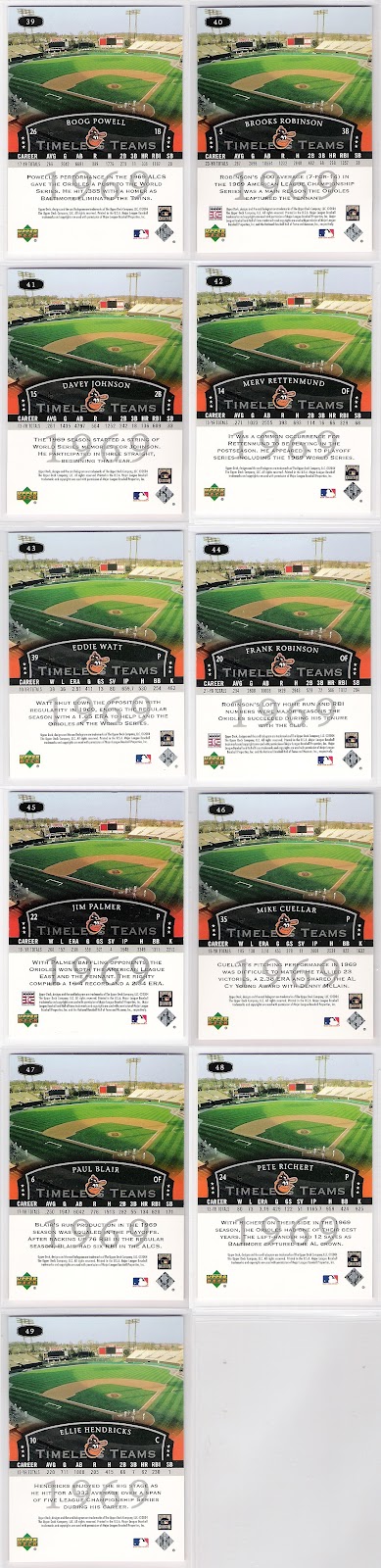
this post covers the 1969 baltimore orioles and cards number 39 to 49 in the set. here are the fronts:
and backs:
for the third time, we have a team without a 'memorable moment'.  we also have 11 players featured - by far the most we've seen so far.  all the players that were featured in the previous orioles post (1966) are still with the team and included in the set. 

what team is this:  1969 baltimore orioles

why this team?:  the '69 orioles won 109 games in the first year of divisional play.  they beat the minnesota twins in the american league championship series 3 games to none, but then ran into the amazing mets in the world series.

which players are featured?:  boog powell, brooks robinson, davey johnson, merv rettenmund, eddie watt, frank robinson, jim palmer, mike cuellar, paul blair, pete richert, and ellie hendricks

why these players?:  these guys were, for the most part, the core of the orioles' dynasty of the late 1960's.

boog powell was named to the all-star team for the second time, and finished 2nd in the league mvp voting (behind harmon killebrew) in 1969 thanks to his 37/121/.304 line.  he hit .385 with a solo home run in the alcs and then had 5 hits (none for extra bases) in the world series, batting .263 against the mets.

brooks robinson hit only .234 in the regular season, but still won another gold glove.  he hit 23 homers and drove in 84 runs along the way, and then hit .500 (7 for 14) in the alcs.  in the world series, he was limited to a single in 19 at bats for a lowly .053 average.

davey johnson was the orioles' second baseman and hit .280 in the regular season.  he was named to the all-star team for the second season in a row, and won his first gold glove.  johnson actually had a better postseason in 1966 (his rookie year) than he did in 1969.  maybe upper deck should have included him with that team instead of this one.  in the alcs he hit only .231 and then managed just one hit in the world series for an average of .083.

merv rettenmund's inclusion in this set with this team is kind of a headscratcher.  he wasn't a regular, appearing in 95 games and hitting .247 during the regular season. in the postseason, he made a single appearance in each the alcs and the world series, without an at bat in either.

eddie watt shared the 'closer' duties with pete richert.  he saved 16 games and had a 1.65 era in 56 appearances.  in the alcs, watt pitched 2 perfect innings.  after a scoreless two-inning outing in game 4 of the world series, watt wound up taking the loss in game 5 despite giving up just a single unearned run.

frank robinson was right behind boog powell in the 1969 al mvp vote, hitting .308 while slugging 32 homers and driving in 100 runs for the final time in his career.  he hit .333 with a home run in the alcs and added a solo shot in the world series, although his average over those 5 games against the mets was just .188.

jim palmer did not pitch in the majors in 1968 (he appeared in only 10 minor league games that year) but returned to the orioles' rotation for the 1969 season.  he wound up with a record of 16-4 in 23 starts.  he threw 11 complete games and 6 shutouts and also made 3 relief appearances.  he was 1-0 against the twins in the alcs, throwing another complete game, and then lost game 3 of the world series by allowing 4 runs in 6 innings of work.

mike cuellar was the al cy young award winner in 1969, although he didn't lead the league in any major pitching category.  he won 23 games (2nd in the league) and had a 2.38 era (third).  cuellar had a no-decision in his lone alcs start, and then earned the win in game 1 of the world series.  he returned to the mound a few days later to start game 4 which the orioles eventually lost in 10 innings.

paul blair won his second gold glove and made the all-star for the first time in 1969.  the orioles' center fielder posted a solid line of 26/76/.285, with the home run and rbi totals proving to be career highs.  he was the orioles' offensive star in the three game sweep of the twins, hitting a home run and driving in 6 runs while batting .400.  he hit only .100 in the world series, however.

pete richert was the left-handed complement to eddie watt in the orioles' bullpen.  he appeared in 44 games and saved 12 of them.  he pitched a single scoreless inning in the alcs, and then failed to record an out in his only world series appearance.  that appearance came in game 4, as richert was called upon in the 10th inning with runners on first and second and no outs.  jc martin pinch-hit and sacrificed, but was hit by richert's throw to first and the winning run scored.

ellie hendricks hit 12 homers for the orioles in 1969.  the catcher appeared in 105 games for the al champs and played in all three alcs games.  he had 2 doubles and 3 rbi in that series, but just one hit in the three games of the world series in which he appeared.

the stadium on the back is...?:  memorial stadium.

did upper deck get it right?:  the team is a good one.  the orioles' 109 wins were the most since the 1961 yankees won 109 and the most until the yankees won 114 in 1998.  the players featured include pretty much all of the key players except for mark belanger (d. 1998), dave mcnally (d. 2002), and don buford who is still around and would have been a good choice to include in place of merv rettenmund. 

the stadium on the back is appropriate, but the bird logo on the front is still wrong.  as for the player photos, boog's photo is not from 1969, but from anywhere between 1971 through 1974 when the o's went with the three stripes on their sleeves.  this is interesting because the photo they use for boog in the 1970 team grouping is more like what they used for the 1966 team.  strange. 

next, we have brooks robinson who is rocking the white panel helmet and the orange pullovers that the orioles wore in the mid-1970's.  not 1969 for sure.  davey johnson looks ok, but merv rettenmund has those tri-color stripes on his sleeve, so he's definitely not from 1969.  eddie watt and frank robinson both look good (although they would likely be showing the '100th anniversary' patch on their sleeves if the photos were from 1969.  jim palmer is rocking a post-1974 look and this may be a photo from the 1980s.  finally, mike cuellar is spot on with the patch!  the rest of the players are certainly shown circa 1969, but likely not from that specific year.  it's nice that upper deck didn't use a photo of ellie hendricks from his third go-around with the orioles in 1978.

is this team timeless?:  i suppose.  this may have been the best orioles team of that era, despite losing four straight games to the mets in the world series.  what do you think?

Friday, January 13, 2012

1967 boston red sox

this post covers the 1967 boston red sox and cards number 13 to 17 in the set. here are the fronts:
and backs:
for the first time, upper deck goes to five players to represent a team.  and the 1965 twins are still the only team without a 'memorable moment'. 

let's break it down.

what team is this: 1967 boston red sox

why this team?:  the red sox went 92-70 in 1967 to win the american league pennant by one game over the twins and tigers.  in their first fall classic appearance since 1946, the red sox took the cardinals to 7 games before faltering and losing the series.

which players are featured:  carl yastrzemski, jim lonborg, george scott, sparky lyle, rico petrocelli

why these players?:  well, we have the american league mvp who also won the triple crown and a gold glove, the american league cy young award winner, another gold glover and the starting shortstop for the american league all-star team.  1967 rookie reliever sparky lyle also makes the cut, probably because he is 'checklist friendly'.

carl yastrzemski was, at 27, the oldest regular on the team.  he was named the starting left fielder for the american league in the all-star game, won the gold glove, and earned the mvp award thanks to his triple crown numbers - 44/121/.326.  then, in the world series, yaz hit .400 with 3 homers and 5 rbi.  notice how upper deck declared him the last man to win the triple crown on his memorable moments card.  maybe this year matt kemp will make that claim incorrect.

jim lonborg, the pride of santa maria, won 22 games for the red sox in 1967.  he was voted the cy young award winner for the american league as he led the league in wins, strikeouts (246) and games started 39.  his 3.16 era, however, was over a full run greater than league leader joe horlen.  otherwise, the red sox would have boasted a pitching triple crown winner as well.  in the world series, lonborg was spectacular in his first two starts.  he threw a 1-hit shutout to even the series in game 2, and then tossed a 3-hitter in game 5, allowing just a solo home run to roger maris in the 9th inning.  in game 7, however, lonborg was pitching on 2 days rest and gave up 7 runs as the cardinals dashed the hopes of red sox nation.

george scott won a gold glove at first base in 1967 while hitting over .300 as a 23-year old.  he finished 10th in the league mvp voting, but hit just .231 in the world series with a double and a triple to his credit.

sparky lyle made his big league debut on july 4, 1967.  he wound up appearing in 27 games for the bosox on their run to the pennant, going 1-2 with 5 saves while posting an era of 2.28.  of course, we know that he made all of those appearances in relief as he never made any starts in his career.  lyle did not appear in the fall classic as the red sox went with 18-year old ken brett as their lefty reliever instead.

rico petrocelli was named the starting shortstop for the american league in the all-star game in 1967.  according to baseball reference, petrocelli had 13 go-ahead hits in 1967, so maybe the text on the back of his card is not just lip service.  petrocelli hit only .200 in the world series, but 3 of his 4 hits were for extra bases, including 2 home runs.

the stadium on the back is...?:  fenway park, of course.  that's where the red sox have played since 1912.

did upper deck get it right?: knowing that the set also includes the world champion cardinals (they'll be next up on the blog) i won't complain about the team selection.  they also got the stadium right, but it looks to be a photo from 2003 or so.  the monster seats are in place above the green monster in left, and those weren't installed until that year.

as far as the players go, yaz is a no-doubter, although upper deck used a photo from much later in the hall-of-famer's career.  i take no issue with the lonborg selection, and george scott and petrocelli make sense, too.  it seems like lyle is a stretch for the sake of the team, but for the sake of the set checklist he may be appropriate as he was a big part of the yankees' 1977 team which is featured later on.

i would suggest that instead of lyle, maybe lee stange or reggie smith would have been better surviving representatives of the 1967 red sox.  at least we didn't get stuck with ken harrelson.

the photos for lonborg, lyle and petrocelli seem to be of the period, but scott's photo, however, shows him with a uniform from the 1969-1971 era. those were the years scott played in boston when the navy 'boston' lettering was outlined in red.

is this team timeless?: i suppose so.  it was the first red sox team to get back to the world series since ted williams' time in boston, and they battled back from a 3-1 deficit to force a 7th game.  throw in the numbers that yaz and lonborg put up in '67 and you've got a keeper.

Friday, January 6, 2012

1965 minnesota twins

this post covers the 1965 minnesota twins and cards numbered 5 to 8 in the set. here are the fronts:

and backs:
at least the text on each of the backs actually pertains to the 1965 season.  that's a first for this set.

what team is this: 1965 minnesota twins

why this team?:  the twins won 102 games in their fifth season in minnesota and represented the american league in the world series.  they took the dodgers to 7 games, but lost to sandy koufax.

which players are featured:  harmon killebrew, jim kaat, jim perry, mudcat grant

why these players?:  kaat, perry, and grant were the aces of the staff for the twins in 1965, and killebrew was, well, the killer. 

in 1965, harmon killebrew hit fewer than 45 home runs for the first time since 1960, when he was playing for the washington senators.  his 25 homers still led the team, and he scored 78 runs while driving in 75 others in only 113 games.  in the world series, killer hit .286 with a homer and two rbi.

jim kaat was 18-11 with 2 'saves' for the al champs.  his era was 2.83, and his 42 starts led the team.  he pitched 7 complete games and 2 shutouts.  he made 3 starts in the world series, finishing 1-2 with a 3.77 era.  he also won (of course) a gold glove - number 4 of 16 straight - and hit .247 with a home run during the regular season. 

jim perry split the 1965 season between the bullpen and the starting rotation.  he finished 12-7 with a 2.63 era in 36 games, 19 of which were starts.  he had 4 complete games and 2 shutouts for good measure.  perry, who would become the ace of the staff on the twins' al west champion teams of 1969 and 1970, made only 2 appearances in the 1965 series, pitching 4 innings in relief and allowing 2 runs.

had there been a cy young award for both leagues in 1965 (or if there were no sandy koufax), mudcat grant may well have won it.  he finished 7th in the league mvp voting, behind white sox reliever eddie fisher, but the twins' mvp vote was split between versalles, oliva and earl battey who all finished in the top 10.  i would imagine fisher and orioles' reliever stu miller (he was 8th in the mvp vote) would have split the reliever vote and grant would have won.  anyway, he was 21-7 with a 3.30 era and 1.16 whip.  he started 39 games and pitched 270 innings, completing 14 games and throwing 6 shutouts.

the stadium on the back is...?:  the hubert h. humphrey metrodome.  this is a gross oversight by the folks at upper deck.  the twins played in metropolitan stadium (now the site of the mall of america) from 1961 through 1981 before moving into the metrodome in 1982.  met stadium was torn down in 1985, although there are markers within the nickelodeon universe in the center of the mall at the location of home plate and of harmon killebrew's 520-foot home run.

did upper deck get it right?: well, we know they blew it with the stadium, but i think they did ok with the player selection.  although it was a down year for killebrew, he did finish 8th in the league in home runs despite playing in only 113 games.  still, the twins had at least one other offensive player who deserved consideration for the set.  tony oliva, who is still around and not opposed to signing autographs, led the league in hits with 185 and batting average at .321, finishing second to teammate zoilo versalles in the mvp vote.  he also finished in the tops 5 in war at 6.0, just ahead of teammates jimmie hall and killebrew.  speaking of hall, he would have been a nice inclusion in the set, but i am biased in that regard. unfortunately, versalles died in 1995, otherwise he would have been a shoo-in for the set. 

the trio of pitchers upper deck chose were spot on, although a case could be made for al worthington, the team's closer.  he was 10-7 in 62 games of relief with 21 'saves' and a 2.13 era.

as for the photos, the killebrew is certainly from the 1970's, thanks to the baby blues and the elastic waist pants.  i have no qualms with the kaat or grant photos, but the perry looks like it may be from later in the decade, due to the amount of gray hair visible on what should have been a 29-year old.  but, then again, his brother gaylord was only 36 when he looked 60 on his 1976 topps card.

is this team timeless?: as far as twins teams go, yes.  and, it's hard to find fault with a team that won 102 games and boasted a slugger who retired at number 5 on the all-time home run list.  i'll give upper deck credit for going with a small market team in this set, but the 1965 dodgers would have been a more obvious choice as they were the world champions, and it would have been nice to see sandy koufax, claude osteen, jim lefebvre, maury wills and maybe wes parker or ron fairly in the set.